Introduction
Watching a child grow is one of the most fascinating parts of parenting.
During the early years, children are constantly learning new skills. They learn to move their bodies, communicate their needs, solve problems, build relationships, manage emotions, and gradually become more independent.
But supporting child development doesn’t mean creating a strict educational program at home or filling every moment of the day with structured activities.
In fact, some of the most valuable learning opportunities happen during ordinary moments.
- Getting dressed.
- Helping prepare a snack.
- Looking at a picture book.
- Building with blocks.
- Talking during a walk.
- Cleaning up toys.
- Playing pretend.
- These everyday experiences give children opportunities to practice important developmental skills naturally.
In this guide, we’ll explore the major areas of early childhood development and practical ways parents can support healthy growth through play, routines, conversation, independence, and meaningful everyday experiences.
What Is Child Development?
Child development refers to the gradual process through which children grow and acquire new physical, cognitive, language, social, and emotional skills.
Development begins at birth and continues throughout childhood. Although children generally follow recognizable developmental patterns, there is no single timetable that applies perfectly to every child.
One child may begin talking earlier, while another may develop physical skills more quickly. Some children are naturally more social, while others prefer observing before joining an activity.
Understanding this variation can help parents focus on supporting their child’s individual development rather than constantly comparing them with other children.

The goal isn’t to make children reach every milestone as quickly as possible. The goal is to provide a safe, supportive environment where children have opportunities to learn, practice, explore, and grow.
The Five Major Areas of Child Development
Child development is often discussed in several interconnected areas.
These areas don’t develop separately. They constantly influence one another.
1. Physical Development
Physical development includes the growth and strengthening of the body.
It includes both:
Gross motor skills, such as:
- Walking
- Running
- Jumping
- Climbing
- Balancing
- Throwing
And fine motor skills, such as:
- Grasping objects
- Turning pages
- Using utensils
- Drawing
- Building
- Buttoning clothing
- Using scissors
Physical development allows children to interact with their environment more independently.
2. Cognitive Development
Cognitive development refers to how children think, learn, remember, understand, and solve problems.
Young children are constantly developing cognitive skills when they:
- Sort objects
- Complete puzzles
- Build structures
- Ask questions
- Explore cause and effect
- Remember routines
- Compare objects
- Make predictions
- Experiment with different solutions
For example, when a child tries several ways to fit a puzzle piece into the correct space, they’re doing more than playing.
They’re practicing observation, memory, problem-solving, persistence, and spatial reasoning.
This is why learning through play is such an important part of early childhood.
3. Language and Communication Development
Language development allows children to understand others and express their own thoughts, needs, feelings, and ideas.
Parents can support language development through simple everyday interactions. Talk to your child about what you’re doing.
Instead of simply saying:
“Let’s get dressed.”
you might say:
“We’re putting on your blue shirt. First one arm, and now the other.”
These small conversations expose children to vocabulary and sentence structure while connecting language to real experiences.
Reading aloud is another powerful way to introduce children to new words and ideas.

4. Social-Emotional Development
Social-emotional development involves learning how to understand feelings, build relationships, communicate with others, and gradually manage emotions.
Young children are still learning how to regulate strong feelings.
A toddler who has a meltdown isn’t necessarily being “bad.” They may simply lack the language and emotional skills necessary to communicate what they’re experiencing.
Parents can support emotional development by helping children name feelings.
For example:
“You look frustrated because the block fell down.”
or:
“You’re sad because it’s time to leave the park.”
Naming emotions doesn’t make difficult feelings disappear, but it helps children gradually connect words with their internal experiences.
Over time, this can make it easier for children to communicate rather than relying only on crying, yelling, or other behaviors.
5. Adaptive and Independence Skills
Children also need opportunities to learn how to participate in everyday life.
These skills can include:
- Eating independently
- Washing hands
- Putting toys away
- Getting dressed
- Carrying belongings
- Helping with simple household tasks
- Making age-appropriate choices
Parents sometimes do these things for children because it’s faster.
And sometimes, of course, adults need to step in.
But whenever there is enough time and it is developmentally appropriate, allowing children to participate can build confidence and independence.
Why Play Is So Important for Child Development
Play isn’t simply a way to keep children entertained.
For young children, play is one of the primary ways they learn about themselves and the world around them.
During play, children practice:
- Communication
- Coordination
- Problem-solving
- Creativity
- Social interaction
- Emotional expression
- Concentration
- Decision-making
A child building a tower with blocks is experimenting with balance.
A child playing with dolls may be practicing social communication.
A child pretending to cook may be exploring everyday routines.
A child completing a puzzle is practicing problem-solving.
This is why parents don’t need to feel guilty when children spend time playing rather than completing formal worksheets or academic activities.
Play itself can be deeply educational.
Open-Ended Play and Creativity
Open-ended toys and activities are particularly useful because they don’t have only one correct outcome.
For example, a set of wooden blocks can become:
- A house
- A bridge
- A tower
- A garage
- A castle
There isn’t necessarily one “right” way to use them.
This encourages children to make decisions and experiment with their own ideas.
Other examples include:
- Building blocks
- Magnetic tiles
- Play dough
- Drawing materials
- Pretend-play objects
- Wooden figures
- Nature materials
Open-ended play can also encourage children to spend more time concentrating on an activity because the possibilities aren’t immediately exhausted.
Activities That Support Fine Motor Development
Fine motor skills are important for many everyday tasks. Parents can encourage fine motor development through simple activities such as:
Building
Stacking blocks requires children to coordinate their hands and eyes while controlling the amount of force they use.
Threading
Lacing cards, large beads, and threading activities can encourage finger control and hand-eye coordination.
Drawing
Allowing children to experiment with crayons, washable markers, and pencils gives them opportunities to strengthen hand muscles and practice controlled movements.
Transferring
Using spoons, cups, tongs, or scoops to move safe materials from one container to another can be a simple and engaging activity. Always choose materials appropriate for the child’s age and supervise activities involving small pieces.
Activities That Support Gross Motor Development
Children need opportunities to move.
Whenever possible, provide time for:
- Running
- Jumping
- Dancing
- Climbing
- Throwing balls
- Walking
- Balancing
- Outdoor exploration
You don’t need expensive equipment.
A simple walk through the neighborhood can provide opportunities to practice balance, coordination, observation, and physical movement.
Outdoor play also gives children opportunities to experience different surfaces, sounds, textures, temperatures, and natural environments.
How Reading Supports Child Development
Reading is one of the easiest ways parents can support several developmental areas at once.
A single picture book can encourage:
Language: New vocabulary and sentence structures.
Cognitive skills: Remembering events and predicting what comes next.
Social-emotional development: Understanding characters’ feelings.
Imagination: Exploring places and situations beyond everyday life.
Connection: Spending focused time with a parent or caregiver.
You don’t need to read for an hour.
Even a short, consistent reading routine can become a meaningful part of a child’s day.
For more ideas, you can also explore our Kids’ Book Recommendations category.
Everyday Activities Are Learning Opportunities
Some of the best developmental activities don’t look like traditional “learning activities” at all.
Consider inviting your child to participate in everyday tasks.
For example:
In the Kitchen
Children can help:
- Wash fruits and vegetables
- Stir ingredients
- Pour water
- Set the table
- Sort utensils
During Laundry
Children can:
- Match socks
- Sort clothing
- Carry lightweight items
- Put clothes into drawers
Around the House
Children can:
- Wipe a table
- Put toys away
- Dust
- Water plants
- Help organize belongings
These activities can support coordination, sequencing, language, responsibility, and independence.
Extra Reading: 10 Easy Montessori Activities to Do at Home with Toddlers
Creating an Environment That Supports Development
Children learn from their surroundings.
A supportive environment doesn’t need to be expensive or Pinterest-perfect.
Instead, think about whether your child can safely:
- Reach appropriate toys
- Access books
- Move freely
- Make simple choices
- Participate in daily routines
- Explore different materials
- Practice skills independently
This is one reason Montessori-inspired environments can be helpful for young children.
The emphasis is often placed on accessibility, simplicity, order, and independence.
For parents interested in this approach, our Montessori At Home section offers practical ideas for incorporating Montessori principles into everyday family life.
Why Routines Matter
Predictable routines can give children a sense of security.
When children know what usually happens next, transitions may become easier to understand.
A simple morning routine might include:

- Wake up
- Get dressed
- Eat breakfast
- Brush teeth
- Prepare for the day
A bedtime routine might include:
- Bath
- Pajamas
- Brush teeth
- Choose a book
- Read together
- Bedtime
Routines don’t have to be rigid.
The goal is simply to provide enough predictability that children can gradually understand and participate in daily life.
Encouraging Problem-Solving Instead of Immediately Helping
Parents naturally want to help when their child struggles.
However, stepping in too quickly can sometimes remove an important learning opportunity.
If your child can’t complete a puzzle, for example, try asking:
“What could we try?”
or:
“Where do you think this piece might go?”
Rather than immediately showing the answer, give your child a moment to experiment.
This teaches an important message:
“I can try again.”
That mindset can become valuable far beyond childhood.
The Importance of Independence
Independence doesn’t mean leaving children to figure everything out alone.
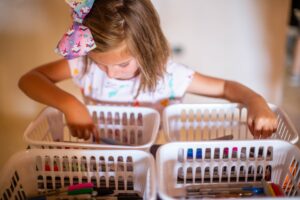
It means giving them appropriate opportunities to participate.
A two-year-old might put a toy away.
A three-year-old might choose between two outfits.
A four-year-old might help prepare a simple snack.
A five-year-old might organize part of their belongings.
The exact task matters less than the opportunity to contribute.
When children experience success with age-appropriate responsibilities, they begin developing a sense of competence.
Supporting Emotional Development During Difficult Moments
Children will have tantrums.
They will become frustrated.
They will cry when plans change.
They will sometimes struggle to share.
These experiences are part of learning emotional regulation.
Instead of expecting young children to manage emotions like adults, parents can gradually teach emotional skills through modeling and connection.
You might say:
“You’re really upset right now. I’m here with you.”
Once the child is calmer, you can discuss what happened.
This teaches children that emotions are normal while also helping them learn appropriate ways to express them.
Does Supporting Development Mean Constantly Teaching?
No.
This is an important point for parents.
You don’t need to turn every moment into a lesson.
Children need:
- Free play
- Rest
- Quiet time
- Unstructured exploration
- Connection
- Movement
- Opportunities to simply be children
A healthy childhood isn’t measured by how many educational activities a parent completes each day.
Sometimes the best thing you can do is provide a safe environment, step back, and allow your child to explore.
Choosing Products That Support Child Development
Parents don’t need to purchase dozens of educational toys.
Instead, consider whether a product offers a meaningful opportunity for your child to do something.
For example:
- Build
- Sort
- Stack
- Match
- Pour
- Draw
- Create
- Explore
- Pretend
- Practice independence
When choosing toys or children’s products, consider:
Age Appropriateness
The product should match your child’s developmental abilities.
Safety
Always follow manufacturer safety recommendations and supervise children appropriately.
Purpose
Ask yourself what the child can actually do with the item.
Longevity
Open-ended products that can be used in different ways may remain interesting longer.
Quality
Choose durable products that can withstand regular use.
A Simple Daily Child Development Checklist
Parents don’t need to follow a complicated schedule.
Instead, try to include opportunities for these five things throughout the day:
☐ Move — Give your child time for physical activity.
☐ Talk — Have real conversations throughout the day.
☐ Play — Allow time for independent and open-ended play.
☐ Connect — Spend some uninterrupted one-on-one time together.
☐ Participate — Invite your child to help with an everyday task.
Even simple routines can provide rich developmental experiences.
❓ Frequently Asked Questions About Child Development
What is the most important thing parents can do to support child development?
Providing a safe, responsive, and supportive environment is one of the most important foundations. Talking, reading, playing, responding to children’s needs, and giving them opportunities to explore and practice independence can all support healthy development.
Are educational toys necessary for child development?
No. Toys can provide valuable opportunities for learning, but children can also develop important skills through everyday activities, outdoor play, books, household tasks, and social interaction.
How does play support child development?
Play allows children to practice physical, cognitive, language, social, and emotional skills in an engaging and natural way.
Should parents worry if their child develops differently from other children?
Children develop at different rates, and developmental variation is normal. However, if you have concerns about your child’s development or notice a significant loss of previously acquired skills, discussing your concerns with your child’s pediatric professional is appropriate.
What activities are best for toddlers?
Toddlers benefit from activities that involve movement, sensory exploration, simple problem-solving, language, and opportunities to practice independence. Examples include building, sorting, pouring, reading, outdoor exploration, and helping with simple household tasks.
How can parents support preschool development?
Preschoolers benefit from opportunities to talk, ask questions, play imaginatively, solve problems, participate in household routines, interact with other children, read books, and explore creative activities.
Final Thoughts
Supporting child development doesn’t require expensive toys, elaborate activities, or a perfectly organized home.
Some of the most powerful developmental experiences are already part of everyday family life.
A conversation during breakfast.
A story before bed.
A walk outside.
Building a tower.
Helping put away laundry.
Choosing between two shirts.
Trying to solve a puzzle.
Comforting a child after a difficult moment.
All of these experiences help children learn about themselves and the world around them.
The most important thing parents can provide isn’t a perfect developmental plan. It’s a supportive environment where children feel safe enough to explore, make mistakes, try again, ask questions, and gradually become more independent.
And remember: development is a journey, not a race.
Your child doesn’t need to develop exactly like another child. What matters is providing loving support, meaningful opportunities to learn, and plenty of time to grow at their own pace.